
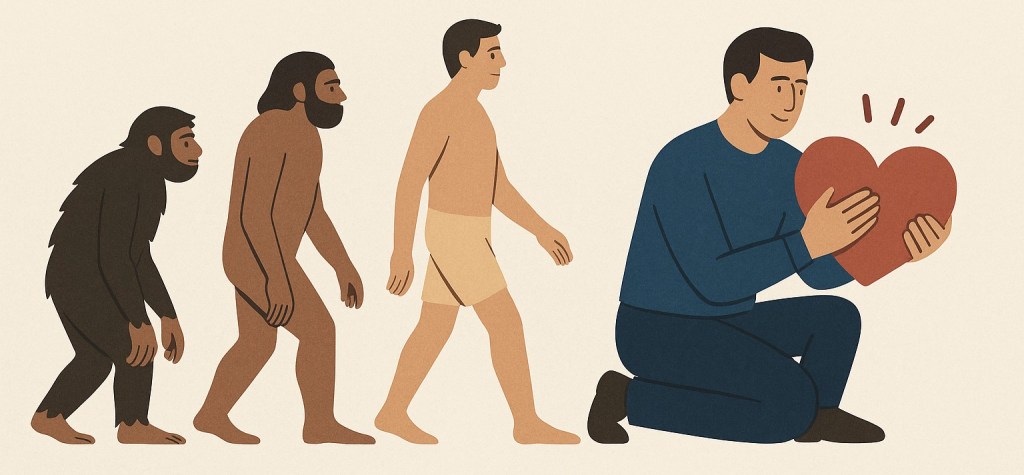
Empathy is widely celebrated but rarely understood in its full complexity. Often mistaken for kindness, emotionality, or intuition, empathy tends to be spoken of as an innate trait, a personality feature that some people simply have and others do not. But as we move deeper into the study of self-awareness and emotional intelligence, a more nuanced truth begins to surface: empathy is not inherited—it is cultivated.
To understand empathy is to first understand sensitivity. Sensitivity is the doorway through which empathy becomes possible, but it is not empathy itself. In fact, sensitivity without awareness can produce the very opposite of empathy, it can lead to overwhelm, misinterpretation, and emotional exhaustion. For those who naturally feel things deeply, this distinction is vital. Emotional intensity, in and of itself, is not a measure of one’s ability to connect with or support others. The depth of feeling may be profound, but without clarity, it risks becoming a burden rather than a bridge.
The Inner Profile Chart Tool
The Inner Profile Chart, a numerological tool introduced in Your Inner Code, explores this dynamic with striking precision. Within its framework, sensitivity emerges through the Emotional Plane and, most notably, through the presence of the number TWO. The traits associated with the TWO include intuition, emotional receptivity, and compassion, but they vary greatly in expression depending on the number’s frequency within a chart. With a balanced presence, typically in the form of two TWOs, an individual tends to exhibit harmonious sensitivity, rooted in understanding and capable of emotional discernment. This balance lays the groundwork for true empathy.
When Sensitivity Becomes A Struggle
But what happens when sensitivity is either underdeveloped or overpowering? The answer to that question reveals the very heart of the confusion surrounding empathy.
Individuals with no TWOs or only a single TWO in their chart are not inherently unemotional or cold. Rather, their sensitivity may be subtle, underpowered, or less instinctively accessible. For these individuals, empathy requires more conscious development because the emotional signals they receive from others are less prominent or harder to interpret. While they are capable of empathy, it may not come as intuitively or consistently as it does for someone whose chart expresses a stronger connection to the Emotional Plane.
Conversely, those with a high number of TWOs (four or more) often experience an emotional environment so saturated with feeling that it becomes difficult to distinguish their own emotions from those of others. They may constantly feel “plugged in” to the emotional states of the people around them, absorbing moods and unspoken tensions with little capacity to create space between external stimuli and their own inner world. This is where a profound misunderstanding occurs. Because these individuals are highly sensitive, they may assume they are also highly empathetic. But raw emotional absorption is not empathy. In truth, it may be the absence of it.
The Active Nature of Empathy
Empathy requires more than the capacity to feel. It requires the capacity to understand, to interpret, and, most critically, to choose how to respond. It is not a passive experience but an active process of emotional integration. When empathy is present, one does not merely absorb another’s feelings; they make sense of those feelings, hold them with care, and offer a response that is supportive, appropriate, and centered. Empathy allows the individual to feel with others, but not instead of them. It allows for connection without collapse.
In this way, empathy can be seen not just as a byproduct of sensitivity, but as its evolution. It is what happens when emotional depth is guided by self-awareness. This is why empathy cannot be presumed based on personality or sensitivity alone; it must be developed. It is something we build by first understanding ourselves and then applying that understanding in relationship to others. Without self-knowledge, empathy becomes distorted, tangled in projection or over-identification. With self-knowledge, it becomes an instrument of clarity, connection, and care.
There is a paradox here worth exploring. Many people who identify as “empaths” or “highly sensitive” experience chronic overwhelm and emotional burnout. They may find themselves exhausted by interpersonal interactions, deeply affected by news and conflict, or paralyzed by the emotional weight of those around them. This exhaustion is often framed as evidence of deep empathy, but what it may actually signify is the lack of empathetic processing. What these individuals are encountering is not empathy but an unfiltered flow of emotional input. They are overwhelmed not because they feel too much, but because they lack the internal structure to understand and respond to what they feel. The sensitivity is real, but the empathy has not yet been activated.
This is where empathy becomes the cure for overwhelm. While it might seem counterintuitive, the development of true empathy brings relief to those who suffer from emotional overload. Empathy introduces boundaries. It creates space between the emotion and the response. It allows the individual to witness another’s experience without internalizing it, and to care deeply without being consumed. Where sensitivity alone is reactive, empathy is reflective. It transforms the chaotic flood of feeling into something structured, meaningful, and manageable.
Building Empathy: A Path Through Self-Awareness
But how does one begin to develop this capacity?
The process starts with self-awareness. One must first learn the language of their own emotions before they can hope to understand someone else’s. This means noticing not just what we feel, but why we feel it; how our history, personality, and beliefs shape our emotional responses. It also means learning to pause before reacting, to reflect before speaking, and to ask ourselves whether the feelings we’re experiencing are truly ours or a reflection of someone else’s state.
From there, we build the skill of interpretation. Empathy is not mind-reading, it is a practice of curiosity and attention. We begin to ask: What might this person be feeling beneath the surface? What might be motivating their behavior? What do they need right now, not just from me, but from themselves? These questions shift our orientation from reactive sensitivity to active understanding.
We also begin to cultivate presence. Empathy is not always about saying the right thing; more often, it is about being the right kind of listener; attuned, grounded, and open. We learn to hold space for others without rushing to fix or absorb their pain. We become a mirror, not a sponge.
Lastly, we learn to honor emotional boundaries, not just with others, but with ourselves. We understand that empathy does not require self-sacrifice. In fact, it depends on self-containment. The most effective empathetic responses come from those who remain rooted in their own clarity while reaching out to others. This is where the true power of empathy lies, not in how much we feel, but in how we choose to feel with.
In the language of the Inner Profile Chart, empathy is the result of multiple planes working in harmony. The Emotional Plane gives us access to intuitive sensitivity; the Mental Plane helps us understand and contextualize what we perceive; and the Physical Plane provides the tools to express our empathy in tangible, grounded ways. When these inner aspects are balanced, empathy arises not as a struggle, but as a natural outgrowth of emotional intelligence.
A Transformational Path
Empathy, then, is not a destination. It is a path, one that begins in the body, is guided by the mind, and is held by the heart. It requires reflection, humility, and above all, practice. For those who are naturally sensitive, empathy may feel just out of reach, not because they lack the capacity, but because they haven’t yet shaped that capacity into something clear and intentional. And for those who find emotional attunement difficult, empathy is still possible. It simply asks for a different kind of effort, rooted in curiosity and the desire to connect.
In both cases, the goal is not to become someone else’s emotional mirror, but to become our own. Through the steady development of self-awareness, sensitivity evolves into empathy and empathy becomes a force not just for understanding others, but for transforming ourselves.
 The Inner Profile Chart
Leave a comment