
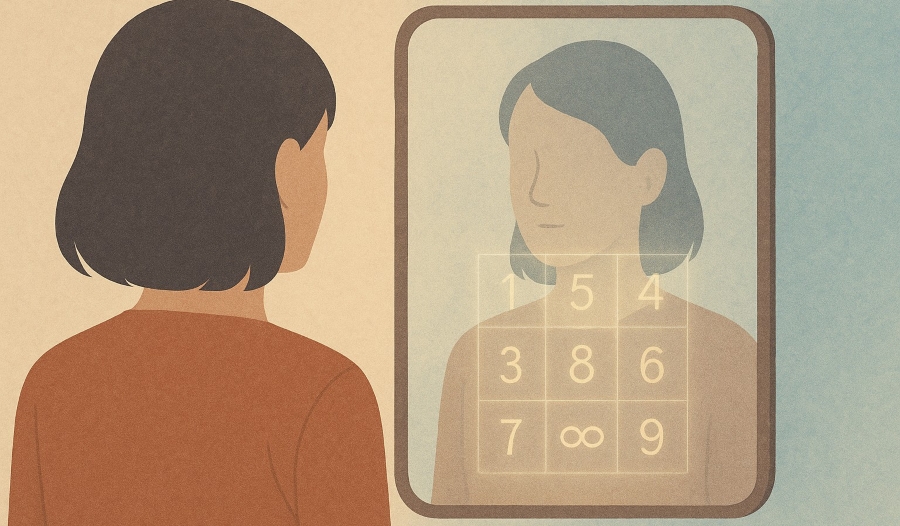
Self-awareness is often praised as the foundation for personal growth, strong relationships, and lasting achievement but truly understanding ourselves remains one of the most elusive goals we face. Our lives and experiences are shaped by an array of hidden influences; habits formed long ago, emotional responses we can’t fully explain, and internal motivations that don’t always match our conscious intentions. For those seeking a clearer view inward, the Inner Profile Chart offers a structured, accessible tool to reveal those hidden dimensions.
What Is the Inner Profile Chart?
The Inner Profile Chart is a self-discovery framework based on an individual’s date of birth. Unlike personality tests that rely on subjective answers or impressions, the chart draws exclusively from objective information. It is a tool that relies on the ancient practice of numerology but it does not lean on its more mystical qualities and beliefs. Using the digits in your birthdate, it builds a framework that an individual can use to identify a series of traits and characteristics that can be applied to better understand their own tendencies and patterns of behavior.
It is constructed using a grid structure providing a distinct position for each number. These, in-turn, correspond to distinct inner traits assigned to each that fall across three core categories or planes
- Mental (thought, memory, idealism)
- Emotional (intuition, sensitivity, wisdom)
- Physical (drive, organization, expression)
In addition to those traits derived from each present digit, the chart’s layout instantly reveals which of these border dimensions are most active and which are under-expressed. It also provides an additional look into how these internal forces interact. This allows for insights that are both granular and holistic, qualities that make the chart uniquely powerful.
Why Self-Awareness Is So Difficult
Most people believe they know themselves well. But studies suggest that true self-awareness; being clear not only about how you see yourself but how others see you, is surprisingly rare. One reason is that introspection, while valuable, is often incomplete or distorted. We replay memories, revisit past decisions, and try to connect the dots, but we do so through the filter of our current mood, mental state, and perosnal assumptions.
Worse, when we seek feedback from others, that feedback is often shaped by their own biases, limitations, and lack of full context. In short, both introspection and external validation have blind spots. The Inner Profile Chart addresses this gap by offering a neutral, repeatable framework that bypasses interpretation and gives you a baseline from which to begin your inquiry.
What Makes the Chart Objective?
The Inner Profile Chart’s objectivity stems from its reliance on the archetypal trait lists that have been consistently applied to specific digits across generations. With each tied to a particular number, these traits are universally fixed and unaffected by personal interpretation or outside opinion.
When you construct your chart using the digits from your date of birth, you aren’t assigning meaning to those numbers yourself. Instead, you’re applying a structured, pre-established framework of characteristics to your unique configuration. These traits are detailed enough to spark meaningful recognition, yet broad enough to leave space for reflection and discovery. That intended balance is what makes the process powerful.
In this way, the chart doesn’t hand you conclusions. It offers an impartial lens, a vocabulary of inner traits from which you construct individual meaning. You are not told who you are; instead, you compare the listed attributes with your own experiences, allowing patterns to emerge on their own terms. It is this contrast between objective input and subjective experience that fosters real insight. The framework encourages self-awareness that is built, not assumed, freeing you from the distortions of memory, mood, or personal bias.
How the Chart Encourages Growth
The Inner Profile Chart is not diagnostic or prescriptive. Rather, it opens the door to interpretation, reflection, and realignment. Seeing a “missing” trait in your chart isn’t a flaw, it’s an opportunity. Recognizing a dominant trait isn’t just a strength, it might also be a source of imbalance or overreliance.
Because each chart is deeply personal, the process becomes highly individualized. Some traits may resonate instantly. Others may feel foreign, prompting deeper reflection. Either way, the goal is the same: to use this snapshot of your inner structure to develop a more conscious, intentional version of yourself.
Beyond the Self: Understanding Others
An unexpected benefit of the Inner Profile Chart is how it improves interpersonal understanding. As users become more familiar with how patterns appear across different charts, they begin to see connections between internal traits and external behavior, not just in themselves, but in others. This awareness can foster empathy, reduce conflict, and provide insight into relationships that previously felt confusing or frustrating.
That said, using this framework to understand others must be done ethically. It should never be used to judge, label, or control. Instead, it offers a lens to approach others with more patience and curiosity, especially when their way of seeing the world differs from your own.
A Non-Spiritual Path to Self-Discovery
While the chart originates from traditions often associated with spiritual or metaphysical thought, its use does not require belief in anything mystical. You don’t need to subscribe to any particular philosophy to benefit. Its power lies in what it reveals, not what it claims. The insights it provides, when approached with openness and honesty, can become a foundation for reflection, clarity, and lasting personal growth.
If you’ve ever felt stuck, misaligned, or misunderstood, even by yourself, the Inner Profile Chart offers a starting point. It doesn’t tell you who you are. It helps you remember, reframe, and rediscover for yourself.
 The Inner Profile Chart
Leave a comment